Customer requirements are increasing. Processes that worked when the company was smaller may no longer be enough. Responsibilities may be unclear. Important knowledge may live in people's heads. Documentation may exist, but not always reflect how work actually happens.
And when ISO 9001 certification enters the conversation, the pressure increases.
WICHPER helps manufacturers turn that complexity into a practical, structured path forward.
You do not need more paperwork. You need a system that works.
A good QMS should not sit beside the operation.
It should help the organization consistently understand requirements, manage its processes, control risks, develop competent people, prevent problems, respond when things go wrong, use evidence to make decisions, and improve performance over time.
That means starting with the business - not with a folder full of templates.
Quality belongs in the operation.
WICHPER's approach is grounded in that simple principle. The objective is to build the smallest effective system your organization can consistently operate, demonstrate and improve.
Different manufacturers need different starting points.
You are considering ISO 9001.
You want to understand what implementing a QMS would actually involve before making major commitments.
A customer is asking about certification.
The pressure is becoming real, and you need to understand where the organization stands and what needs to happen next.
You have decided to pursue certification.
You need a structured implementation path that turns the goal into manageable work.
You are already implementing a QMS.
Progress has started, but gaps, competing priorities or uncertainty are making implementation harder than expected.
You already have a QMS, but it is not working well.
Documents may exist, but ownership, consistency, evidence or improvement are not where they need to be.
Wherever you are starting, the first step is understanding your current state.
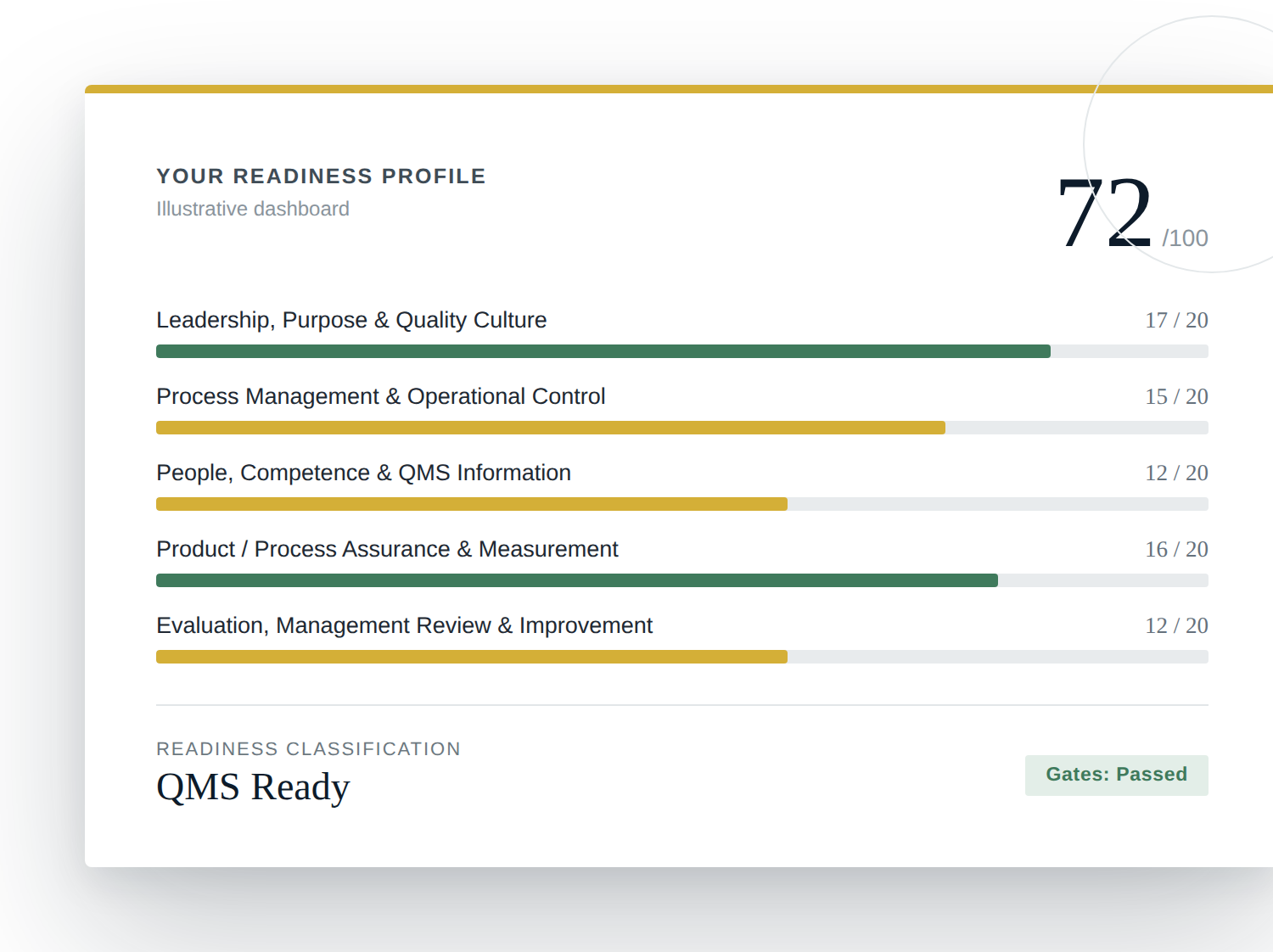
Discover how mature your current quality management practices are.
The QMS Readiness & Maturity Scorecard™ is a practical 25-question assessment designed to help you understand your current QMS maturity and identify where further development may be valuable.
No ISO jargon. No audit. No certification sales pitch. Just a structured starting point.
When you are ready to build, QMS Made Real™ provides the system.
KNOW → BUILD → IMPLEMENT → PROVE → PREPARE
QMS Made Real™ takes manufacturers from understanding their current operation through building, implementing, demonstrating and strengthening a practical QMS. Five stages. One working QMS.